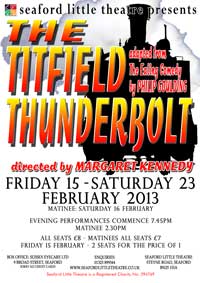
the titfield thunderbolt by philip goulding
- Lady Edna Chesterford
- Clifton
- Mr Blakeworth
- Dan Taylor
- Vernon Crump
Harry Crump - Joan Weech
- Sam Weech
- Mr Valentine
- Miss Coggett
- Mr Ruddock
- Mrs Bottomley
- Sergeant Wilson
- Mr Clegg
- Director
- Stage Managers
- Assistant Stage Managers
- Lighting Design
- Sound Design
- Lighting & Sound
- Continuity
- Set design
- wardrobe
- S
- programme/Poster design
- Angie James
- David Heathcote
- Roland Boorman
- Martin Adams
- Mike Piller
- Lee Powney
- Jenny Humphries
- Roland Boorman
- Mike Piller
- Andrea Lowe
- Phil Armstrong
- Sue Shephard
- Lee Powney
- Phil Armstrong
- Margaret Kennedy
- David & Rosina Heathcote
- Cicely Ridley & peter Barnes
- Gary English
- Alan Lade
- Ian Baldwin & Brenda Clifford
- Sue Shephard
- Alan Lade
- Helena Bell, Marie Mason & Joan Holstead
- Alan lade

The Titfield Thunderbolt Photo Album
click here to view
SEAFORD GAZETTE Review by Derek Watts
First, a confession. I love the Ealing comedies. They were among my earliest experiences of the cinema, especially the British cinema, and the work of the Boulting Brothers – ‘The Lady-killers’, ‘The Lavender Hill Mob’ and ‘Passport to Pimlico’ captivated me before I had escaped short trousers. So a stage version of the charming, whimsical , ‘Titfield Thunderbolt’ promised a heart-warming and thoroughly English evening.
The cast is packed with larger-than-life stereotypes, the play centres on one of those rural branch-line stations of Flanders and Swann’s delicious ‘Slow Train’. And it’s about plucky villagers resisting the closure of their line, fighting progress, the motor-car, the Civil Service and spivs. What’s not to like ?
There was quite a lot to like, if truth be told. Alan Lade’s imaginative set conjured up a kind of acrylic nostalgia – remember those Clarks ads with the boy and girl holding hands ? He coped with the various changes of location by evocative suggestion and his sound effects convinced us we were actually on the platform. Especially effective was the final scene, where the steam and the squeal of brakes announced the arrival of the Thunderbolt at Mallingford and the old engine faced us head on.
There was also some very funny dialogue – but there wasn’t quite enough. There were also some finely-judged performances. Mike Piller was outstanding as first the spiv, trying to get his bus company off the ground , encumbered by a son who was a spanner short of a full set. Overtones of Private Walker in ‘Dad’s Army’ here and in his even more effective depiction of the local lush, Mr. Valentine, we sensed more than once the Major in ‘Fawlty Towers’. Roland Boorman had good moments as the bumbling Town Clerk and the railway-loving vicar who gets to drive the train and Jenny Humphries as his niece provided earnest love interest for the hapless but ultimately heroic Harry Crump, [Lee Powney]. Phil Armstrong, playing two men from the Ministry, was delightful as both -a bluff Northerner trying vainly to run a public meeting and the nit-picking Mr. Clegg, all clipboard and clipped moustache.
It is so easy in these period comedies to succumb to over-acting and Angie James, as the battle-axe with a heart, the local grande-dame, did just that. She was amusing, she got the audience going and her Mrs. Thatcher speech was pretty good, but ‘less is more, dear’. Andrea Lowe looked good and coped with the mock-Welsh as the quasi-trade union rep and Sue Shephard and David Heathcote had telling cameos in and around the station. We needed a real yokel, the ancient and bucolic Dan, like Jim Trott in ‘The Vicar of Dibley’ - but Martin Adams never quite got to grips with the accent, the shuffle and the irascibility of a much older man.
Marget Kennedy grasped the nettle here and on the whole she and her cast rose to the difficult challenge. It was a fun evening, not without its flaws, but it reminded us that no one did whimsy or mock heroics quite like the Ealing Studios.
SEAFORD SCENE Review by Gerrie Purcell
In the great tradition of the classic Ealing Comedies, Philip Goulding’s adaptation of the much-loved film to a stage play presented an enjoyable evening of warm good humour and insight into the variety of characters in a rural community. Set in I952 it is a story of villagers rallying around to run their own branch line when it is threatened by closure, despite the best efforts of wily competitors and the red tape of Transport Ministry officialdom.
In this production Director Margaret Kennedy and the backstage staff should be highly commended for their inventive use of space in the auditorium and evocative use of sound effects, stage-smoke, lighting and excellent set to create a wonderful experience for the audience. It must be said that the audience played their role too, as an aspect of the staging required the audience to participate as either bus or train passengers and for some to act as water carriers to help build up the head of steam at the end of the play.
The charm and wit of the play were brought to life by the enthusiastic and versatile cast, most of whom played two roles and all of whom were convincing in their characters, With stand-out performances by Mike Piller playing both the conniving would-be bus company mogul ‘Vernon Crump’, and the local gentleman bon vivant and drunk ’Mr Valentine’, and also Roland Boorman as train-enthusiast ‘Reverend Sam Weech’, and officious councilman ‘Mr Blakeworth’. Both actors were well-matched alongside the characters of ‘Joan Weech’, played with just the right mix of steely determination and charm by Jenny Humphries and the force-of-nature character of ‘Lady Edna Chesterford’ played with verve and wit by Angie James.
Lee Powney brought a warm mirth to his roles as Vernon’s put- upon son ‘Harry Crump’ and the stiffly backboned ‘Sergeant Wilson’, both of whom ‘took a shine’ to the delectable barmaid Joan Weech — but only Harry won her heart in the end. Phil Armstrong gave strong performances in his roles as ‘Mr Ruddock’ and ‘Mr Clegg’ — the latter being the ‘Man from the Ministry’ who seemed to take too much note of the saucy ‘Miss Coggett’, played with a wiggle and a wink by Andrea Lowe, who made the right decision in the end to uphold the dreams of the village and let them run their own beloved branch line.
Sue Shephard, as ‘Mrs Bottomley’ and Martin Adams as good-old ‘Dan Taylor’, and David Heathcote as ‘Clifton’ rounded out the rest of the superb cast line-up. The audience had great fun and thoroughly enjoyed yet another brilliant show by The Little Theatre.
EVENING ARGUS Review by Tony Flood
For those who love the nostalgia of a 1950s comedy about villagers running a branch railway line when British Rail close it down, Seaford Little Theatre’s production of The Titfield Thunderbolt is just the ticket.
But don’t expect belly laughs because the humour in this dated adaptation of the Ealing film is subtle and whimsical.
Director Margaret Kennedy stays faithful to Philip Goulding’s quaint, warm-hearted script and, after a slow build-up, the play comes into its own in the second act, especially through the banter which Angie James and Jenny Humphries have with the audience as Lady Chesterford and buxom barmaid Joan Weech.
Titfield Thunderbolt’s 14 characters were originally played by five actors, but Seaford Little Theatre uses a cast of ten.
Mike Piller makes a fine Seaford debut as ruthless bus service boss Vernon Crump and hard-drinking publican Mr Valentine. Roland Boorman throws himself into the part of an eccentric vicar.
Images of the train and bus rely heavily on the imagination of the audience, who become passengers and pass down water containers to prevent the express blowing up.
THEATRICAL EASTBOURNE BLOG Review by Stephanie Burton
Link to Blog is here
It was lovely to catch up with old friends at Seaford Little Theatre yesterday evening. The Titfield Thunderbolt is very much a play about the importance of community and there was a strong sense of togetherness throughout the performance.
For me, the star of the show was Alan Lade’s colourful set which not only recreated the village station onstage, but also cleverly allowed the audience to ‘travel’ on both the train and Vernon Crump’s bus. Scene changes were slick and I liked the effective uses of recorded sound. The gentle tale was well-acted with the grand Lady Chesterford (Angie James) and the lush Mr Valentine (Mike Piller) being particularly memorable performances. The Vicar’s (Roland Boorman) delighted anticipation of train driving was adorable.
I love the Little Theatre itself. Such a cute venue and a wonderfully intimate space which the company made full use of. Entrances and exits made through the auditorium added to the sense of our really being in Titfield and the actors did take advantage of the opportunities this gave them to interact with the audience!
I’m pleased I went to Titfield Thunderbolt and, as Seaford Little Theatre is only 45 minutes by train from Eastbourne & easily walked from Seaford station, I will definitely be keeping an eye out for future productions.